
Expert local guides | Curriculum-aligned to US History and Civics standards | Available year round | Less than an hour from Washington DC | Contact: info@dcbyfoot.com
America’s First Capital, Right on Your Doorstep
Your Students Are an Hour From One of the Most Important Cities in American History. Most Schools Drive Past It.
The city where the Revolutionary War officially ended. Where George Washington resigned as General. Where the slave trade brought thousands of Africans to American shores. And where more original 18th-century buildings are still standing than anywhere else in the United States.
Washington DC gets all the attention. Annapolis deserves some of it.
Less than an hour from DC, Annapolis is one of the most historically significant cities in America and one of the most underused field trip destinations for schools in the region. The Maryland State House — the only state house to have also served as the capitol of the United States — is open to student groups. The Kunta Kinte Memorial at City Dock connects American history directly to the slave trade and the story told in Alex Haley’s Roots. The Georgian mansions of the founding era are still standing on the same streets where the founders walked. The US Naval Academy has shaped the nation’s military leadership since 1845.
This is a curriculum goldmine that most DC-area schools have never tapped. We are here to change that.
Why Annapolis Works So Well as a Field Trip Destination
We have been leading student groups through Washington DC for nearly two decades and Annapolis is one of the destinations we recommend most enthusiastically to the teachers who ask us what they might be missing. Here is why.
The history is genuinely extraordinary and genuinely tangible. Most of what your students are learning about in American history class happened in buildings that are still standing in Annapolis, on streets that have not changed significantly in 250 years. The Treaty of Paris was ratified in a room your students can stand in. George Washington’s resignation speech was delivered in a chamber that looks nearly identical to how it did in 1783. That kind of direct connection between the classroom and the real world is rare and powerful.
The full complexity of American history is all here in one place. The founding fathers who signed the Declaration of Independence and the enslaved people who built their mansions. The Naval Academy that trained generations of military leaders and the port that brought thousands of Africans into bondage. Annapolis does not let you tell a simple story about American history. Our guides are experienced at navigating that complexity in a way that is age-appropriate, honest, and genuinely engaging for students.
It pairs beautifully with a DC trip. Many of our school groups combine an Annapolis half-day with a DC day or two-day program, making the most of travel time to the region. The two cities tell complementary stories — DC as the living government, Annapolis as the founding moment — and the combination gives students a richer understanding of American history than either destination delivers alone.
It is genuinely walkable and manageable. The entire tour covers under a mile of walking in a compact historic district. No buses needed between stops. No complicated logistics. Just a guide, a group of students, and one of the most historically dense square miles in the country.
What Students See and Learn
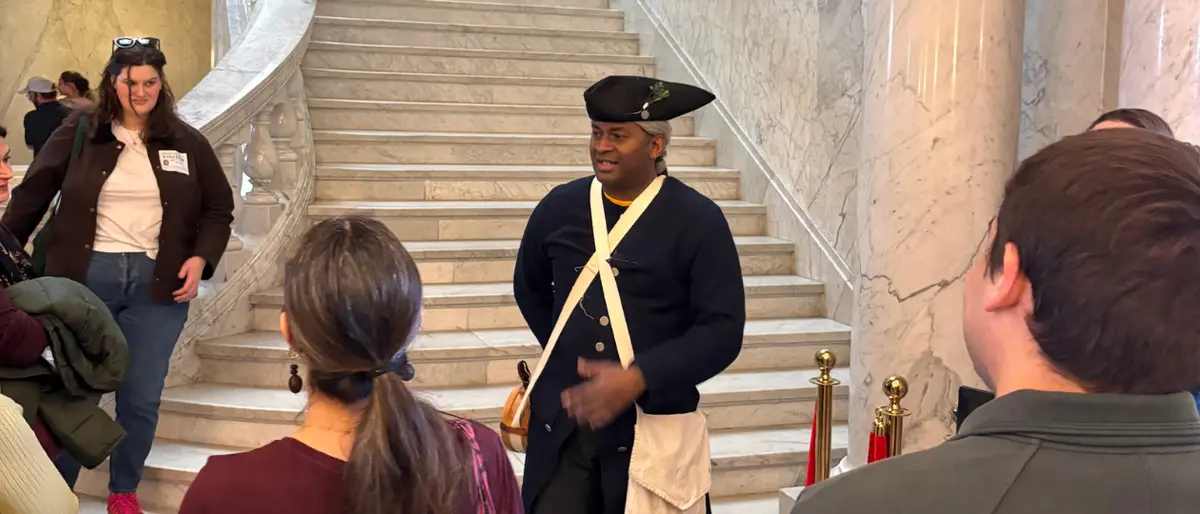
Our Annapolis field trip is a two-hour guided walking experience covering the historic district. Every stop is chosen for its curriculum value and every story is told by a guide who knows how to connect it to what students are already studying.
Maryland State House
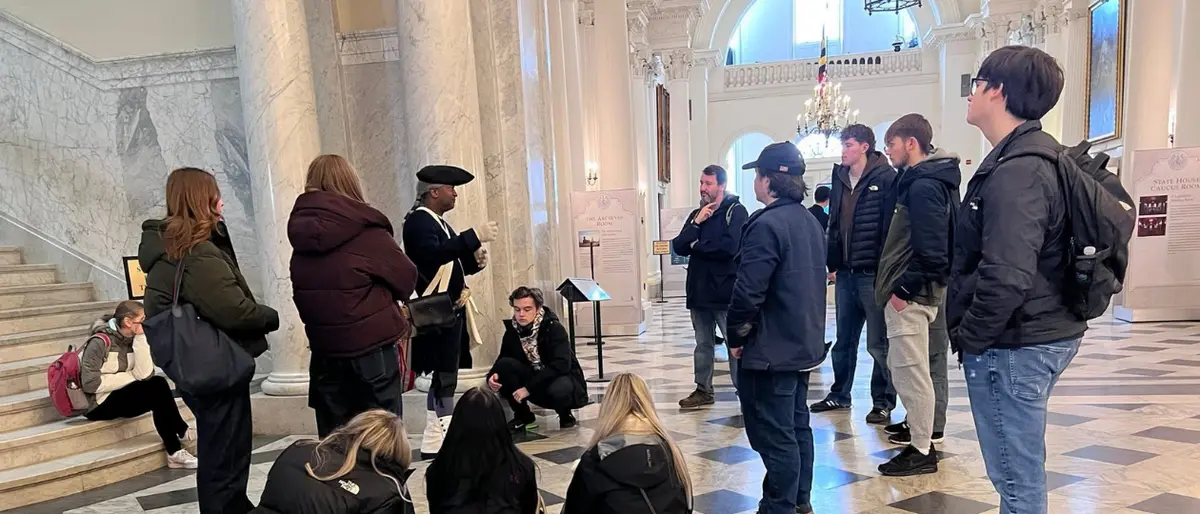
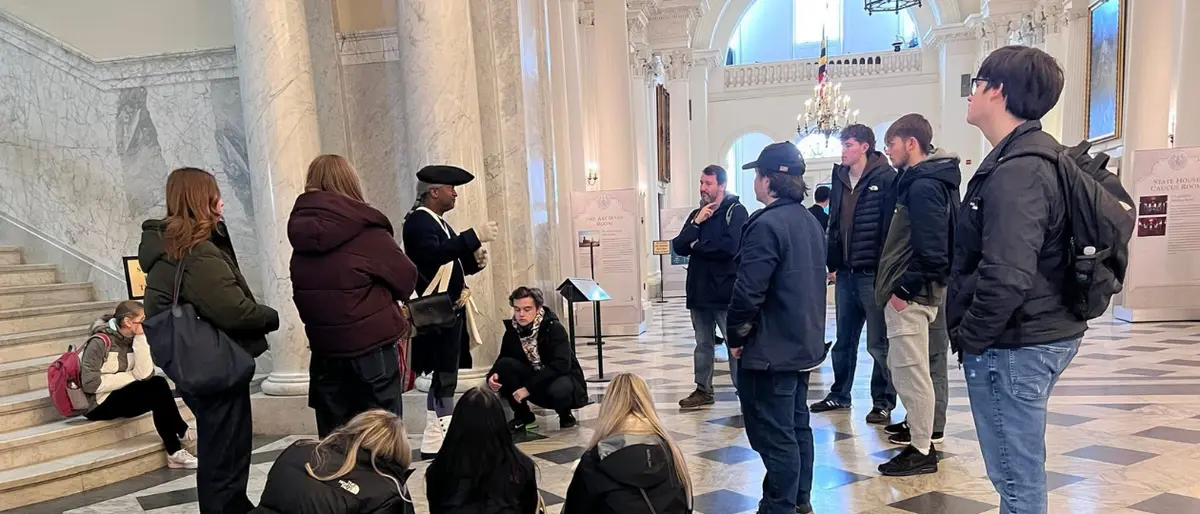
Students spend approximately 30 minutes inside the oldest state capitol building in continuous use in the United States — and the only one to have served as the capitol of the nation. This is where the Treaty of Paris was ratified in 1784, officially ending the Revolutionary War. This is where George Washington stood before Congress and resigned his commission as General of the Continental Army in one of the most consequential moments in the history of democratic governance. Students walk into the same chamber and hear the full story.
Curriculum connections: American Revolution, founding era, democratic governance, primary source analysis.
Kunta Kinte Memorial
At City Dock, students encounter one of the most powerful and least discussed sites in American history. The Kunta Kinte Memorial marks the spot where Alex Haley’s ancestor arrived in America in 1767, enslaved and transported across the Atlantic to the port of Annapolis. The memorial connects the abstract history of the slave trade to a specific person, a specific place, and a specific moment — and invites students to understand American history in its full complexity. Our guides handle this stop with the depth, care, and honesty it deserves.
Curriculum connections: Atlantic slave trade, African American history, primary sources, Roots by Alex Haley.
William Paca House
One of the finest surviving examples of Georgian colonial architecture in America, built by William Paca — a signer of the Declaration of Independence and Governor of Maryland. Viewed from the street with full historical context from the guide, this stop connects students to the lives and motivations of the founders and to the extraordinary concentration of revolutionary-era wealth and power that made Annapolis such an influential city in the late colonial period.
Curriculum connections: Colonial America, Declaration of Independence, founding fathers, Georgian architecture.
Hammond-Harwood House and St. Anne’s Church
The Hammond-Harwood House is considered by architectural historians to be one of the most perfect buildings constructed in colonial America. St. Anne’s Church, established in 1692, sits at the center of one of the two circles that define Annapolis’s baroque street plan — a layout so admired by George Washington that it influenced the design of the nation’s capital. Together these two stops tell the story of how religion, civic life, and architecture were deliberately woven together in colonial Annapolis.
Curriculum connections: Colonial architecture, separation of church and state, city planning, religious history.
City Dock and the Chesapeake Bay
The tour ends at the water — where Annapolis’s story began. City Dock has been the commercial and maritime heart of Annapolis since the city was founded in 1649. Students stand at the same waterfront where tobacco, goods, and enslaved people were loaded onto ships bound for the Atlantic and hear the full sweep of the city’s maritime history, from its founding as a Puritan settlement through its role as a major colonial trading port to the city it is today.
Curriculum connections: Maritime history, colonial economy, Chesapeake Bay, trade and commerce.
The US Naval Academy
The Naval Academy campus is visible throughout the tour and covered extensively in the guide’s narrative. Students learn about the Academy’s founding in 1845, its role in training the nation’s naval officers, and its relationship with the city of Annapolis — including the traditions, the history, and the extraordinary 338-acre waterfront campus. While the tour does not enter the Yard, students leave with a thorough understanding of one of America’s most significant military institutions.
Curriculum connections: US military history, naval history, government and civic institutions.
“We recently completed our second Washington DC trip using DC by Foot, and once again, they were outstanding. From start to finish, the experience was well-organized, flexible, and engaging for both our students and adults. One of the things we appreciate most about DC by Foot is their willingness to customize tours to meet our needs. We highly recommend DC by Foot for any school or group travel.”
Erin Gray, Heartland Christian School, Council Bluffs, Iowa
What Every Annapolis Field Trip Includes
- Expert licensed guide for the full two-hour tour
- Entry to the Maryland State House with approximately 30 minutes inside
- Pre-visit teacher preparation kit with discussion guides and background reading
- Student activity booklet
- Post-visit assessment and reflection tools
- Curriculum alignment documentation for US History, Civics, and Social Studies standards
- Recommendations for what to do before or after the tour in Annapolis
Practical Information for Teachers and Trip Coordinators
Grade levels
Suitable for grades 4 through 12. Content and delivery are adapted to your students’ age and prior knowledge. The tour works particularly well for units on the American Revolution, colonial America, the founding era, and African American history.
Duration and distance
Approximately two hours. Under one mile of walking in a compact historic district. Starts at the Annapolis Visitors Center on West Street and ends at City Dock by the Market House.
Getting there
Annapolis is approximately 45 minutes from Washington DC by bus or car via Route 50 East. The compact historic district makes it ideal for coach drop-off at the Visitors Center. No buses are needed between stops during the tour itself.
Photo ID requirement
All chaperones and adult guests 18 and over must bring a valid government-issued photo ID to enter the Maryland State House. Students under 18 do not require ID. Please communicate this clearly to all adult chaperones before the trip.
Availability
Year round. Annapolis is a particularly rewarding destination in spring and fall when the weather is mild and the historic district is at its most atmospheric. Summer visits are popular for schools pairing Annapolis with a DC program.
Pairing with a DC program
Annapolis works exceptionally well as a half-day addition to a DC school trip. Many of our school groups combine an Annapolis morning or afternoon with one or two days in Washington DC. Contact us and we will build a combined itinerary that makes the most of your travel time.
Book Your Annapolis Field Trip
Contact us to discuss your group’s grade level, travel dates, and curriculum goals. We will build a custom proposal within 48 hours. No commitment required.
Pairing Annapolis with a DC program? Tell us when you inquire and we will put together a combined itinerary covering both destinations.
Returning school? Email us at info@dcbyfoot.com and mention your school’s name — we love hearing from groups we have worked with before and we will make sure your Annapolis trip is just as good as every trip before it.
Ready to start planning?
Let’s Build an Annapolis Experience Your Students Will Remember.
One hour from DC. Two hours of history your students will not find in any textbook. Tell us about your group and we will put together a custom proposal with no commitment required.
Request a Free Quote →Or email us directly at info@dcbyfoot.com